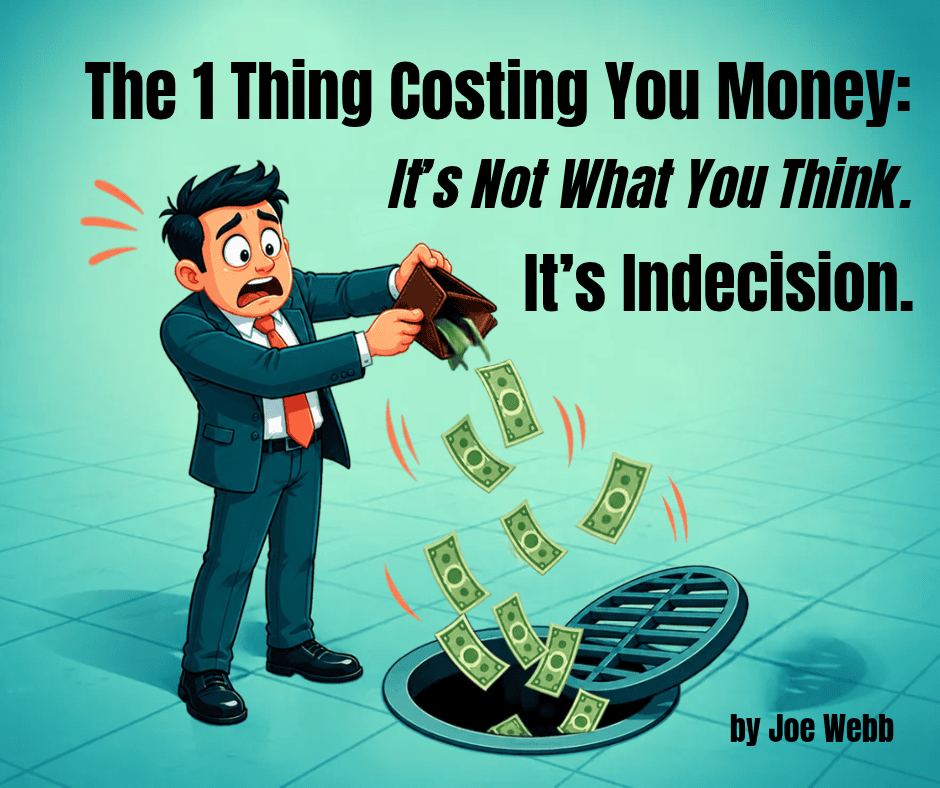
Common phrases business analysts share are “speed to market”, “first in wins”, “time is money”, and a litany of others. All in hopes those with the ability to make decisions do it quickly. Have you adopted these in all aspects of your business or are you costing you money? “Indecision” isn’t a place where the act of deciding happens. It’s business purgatory.
Why does indecision take hold? Because we have been bred to believe there is always more time, and that sometimes making a poor choice is more dangerous than making no choice at all. That couldn’t be further from the truth.
There are phrases we hear regularly that prevent business leaders from being winners.
“We’ve got time.”
“Let’s see how it plays out.”
“Just give it some time.”
“Time heals all wounds.”
“Patience is a virtue.”
Unless these all come with a caveat, you’re doing your business a disservice.
“We’ve got time.” Without stating “… until (outcome) or (worse outcome) occurs, you’re setting yourself up for failure.
“Let’s see how it plays out.” Without stating what the delay costs you if it plays out poorly.
“Just give it time.” Without stating the research that will take place during a specific time frame, you’ll be waiting until it is too late.
“Time heals all wounds.” Wrong, unattended wounds without attention get infected.
“Patience is a virtue.” Recognize it can also be a detriment, or lead to stagnancy. It can be viewed as indifference as well.
Let it be known, making a wrong decision is worse than making a decision wrong. Making a decision wrong means not taking into consideration historical data, personal experience, gut instinct, examining both sides or all consideration sets, research, and facts. All that should be done quickly if you prioritize the decision. Making a wrong decision can be bad, but not if you’re monitoring, measuring, and willing to pull the plug just as quickly as you made the initial decision in the first place.
To get more granular, and less abstract, you could be battling indecision on a number of aspects in your organization.
- You could have a new hire that isn’t cutting it. You’re debating how much time to give them before they figure it out and produce, or if you should let them keep costing you money until they do.
- The CRM, A.I., DMS, video program, or tech currently deployed at your place of business is not serving you, but you don’t want to replace it because of the time/energy/cost/investment of resources/push-back/(insert excuse here). That too is costing you money.
- Your marketing provider isn’t showing you the necessary results or your website provider is catching less and less eyeballs. How much research have you done to see the cause, review the variables, and interview potential partners? None? Then you haven’t even started the process of deciding. At that point, it’s just finger-pointing.
- Or maybe you’re too scared to speak up, put yourself up for that promotion, waiting for the perfect time to take the next step in your career. It is far less likely to happen if you’re always finding a reason to wait, rather than making the decision to go for it. Might you be costing yourself money?
People make mistakes. We all do. No one is perfect. But indecision can cost you far more than making a quick decision. How do you identify if that quick decision was the right solution? You can’t learning from your mistakes if you never make a decision. It takes away your ability to undo the decision and replacing with a better option quickly. By making fast decisions, you give yourself the chance to learn what works and doesn’t work. You’ve tracked your progress, corrected any errors, and completed the experiment. Meanwhile the person hemming and hawing on making any decision at all, or putting said decision on the backburner, has gained nothing. Not moved their business forward at all. That is where you don’t want to be.
Just like anything, decision-making is a process. Indecision is the absence of process. As I wrote above, many elements can come into making a decision, but that doesn’t mean it cannot be done quickly and soundly if you follow a process. Run from indecision and run toward the process of making your best decision quickly. (Doesn’t have to be the right decision so long as you are willing to pivot quickly if there is a better decision to be had.) Time is finite. The time you take to make a decision should be the same.